 +91 97181 19993
 info@kesaria.com
 O-Rings
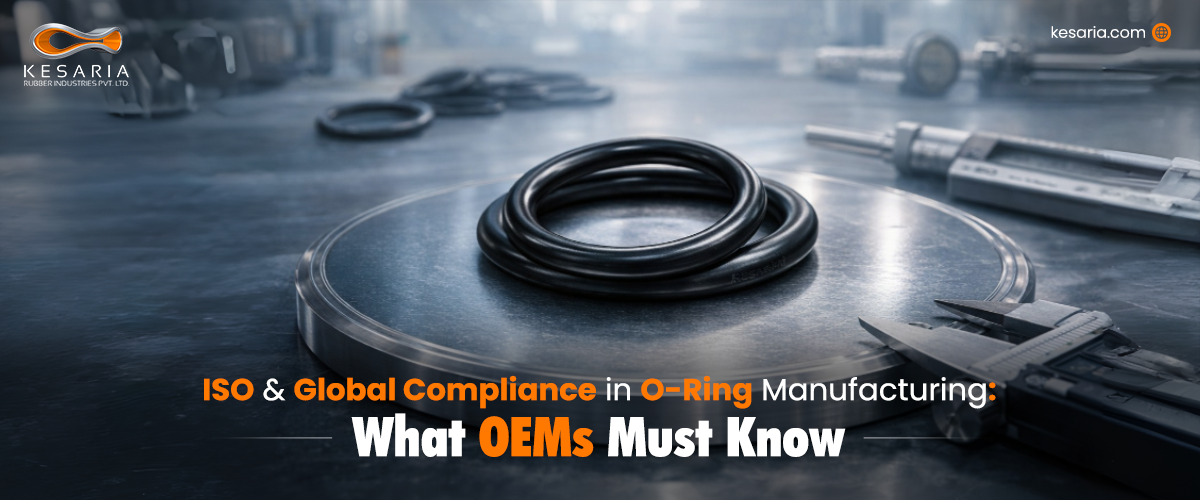
In today’s regulated manufacturing landscape, sourcing an O-ring is no longer just about size and material. For OEMs across industries and sectors, compliance is a must.
Undoubtedly, an O-ring is a tiny component, but if it fails to deliver the purpose, then recalls, warranty claims, legal exposure and reputational damage are the undesirable outcomes.
Here comes the essential role of ISO and global compliance frameworks while selecting the right O-ring manufacturer who can deliver the right product.
Why Compliance Matters in O-Ring Manufacturing?
O-rings operate in critical systems: sealing water lines, preventing fuel leaks, maintaining pressure in hydraulic assemblies or ensuring contamination-free performance in medical devices.
Failure risks include:
- Fluid or gas leakage
- Pressure instability
- Chemical degradation
- Premature compression set
- Regulatory non-conformance
Compliance standards exist to reduce these risks by enforcing documented quality systems, traceability, testing protocols and material control.
Key Certifications OEMs Should Look For
1️⃣ ISO 9001: Quality Management Systems
Ensures standardized processes, documentation control, inspection protocols and continual improvement. For OEMs, this means consistency in every production batch.
2️⃣ IATF 16949: Automotive Quality Standard
Critical for automotive applications, this standard enforces defect prevention, traceability, PPAP documentation and risk-based thinking across the supply chain.
3️⃣ ISO 14001: Environmental Management
Increasingly important for global OEMs focused on ESG and sustainable sourcing.
4️⃣ ISO 45001: Occupational Health & Safety
Demonstrates operational discipline and manufacturing reliability.
5️⃣ WRAS & NSF Compliance: Potable Water Applications
Essential for plumbing, bathware and water-contact sealing components. These certifications validate that materials are safe for drinking water systems.
6️⃣ RoHS & REACH Compliance
Ensures restricted substances are controlled, supporting global export requirements.
Compliance Beyond Certification: What It Really Means
A certificate alone is not enough. OEMs should evaluate whether their O-ring supplier demonstrates:
- Material traceability
- Batch-wise testing documentation
- Dimensional tolerance control
- Compound formulation consistency
- In-house quality labs
- Controlled molding and curing processes
Compliance is a manufacturing discipline.
How Compliance Reduces OEM Risk
When O-rings are manufactured under certified systems:
- Warranty claims decrease
- Product lifecycle improves
- Audit readiness strengthens
- Export approvals become smoother
- Brand reputation remains protected
In highly competitive industries, reliable sealing performance becomes a silent differentiator.
Choosing the Right O-Ring Manufacturing Partner
OEMs should treat O-ring sourcing as an engineering decision, not a cost compromise. A compliant manufacturing partner contributes directly to product reliability, regulatory safety and long-term operational stability.
At Kesaria, we manufacture O-rings and precision sealing components under certified management systems including ISO 9001, ISO 14001, ISO 45001 and IATF 16949. We also supply WRAS and NSF compliant materials where required, along with adherence to RoHS and REACH standards for global markets.
Our products are made in-house which consists of tooling and quality control capabilities too. All these increase traceability, consistency and performance reliability across every batch we deliver. For OEMs, compliance is foundational. And for us, it is embedded into every O-ring we manufacture.