 +91 97181 19993
 info@kesaria.com
 O-Rings
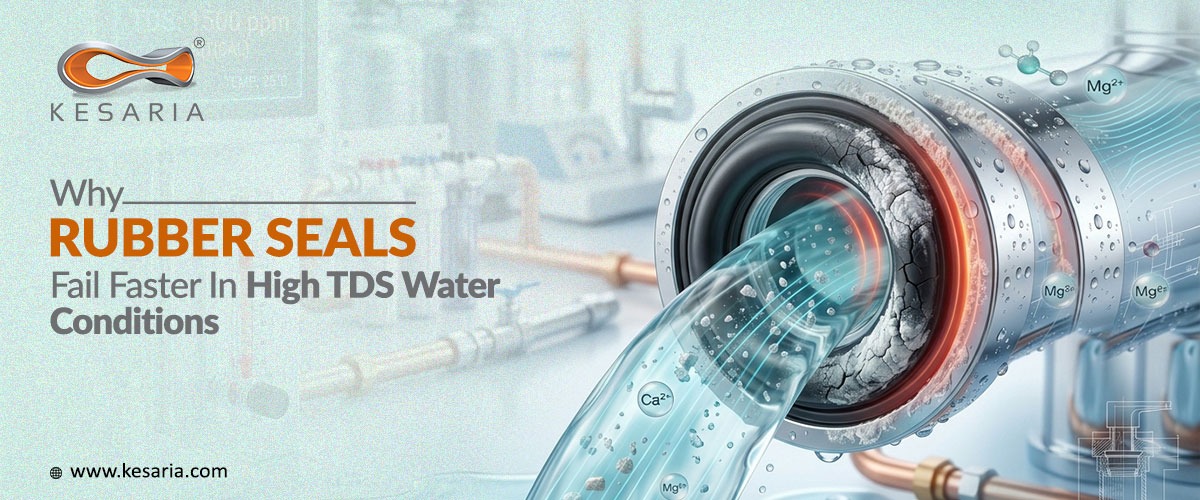
Nobody installs a premium plumbing or bathware system expecting leakage issues within a short period of operation. Yet in many regions across the world, sealing failures occur far earlier than expected, not because of poor installation, but because the sealing material was never designed for the actual water conditions it faces. One of the most overlooked factors behind premature seal degradation is water chemistry.
What Is TDS and Why Does It Matter?
TDS (Total Dissolved Solids) refers to the concentration of dissolved minerals, salts and metals present in water. High TDS water contains elevated levels of substances such as calcium, magnesium, chlorides, sulphates and other dissolved compounds.
For rubber seals this is not simply water flow. Over time it becomes a continuous chemical and mechanical exposure that directly impacts sealing performance, dimensional stability and material life.
How High TDS Water Affects Rubber Seals
1. Mineral Scaling & Surface Abrasion
Hard water minerals gradually deposit on sealing surfaces and mating components. These deposits create abrasive friction during operation, damaging the seal surface and forming microscopic leakage paths.
As scaling increases, seals lose their ability to maintain uniform compression and proper sealing geometry, resulting in reduced performance and eventual leakage.
2. Chemical Degradation
High TDS water often contains aggressive ions that can accelerate polymer degradation in standard rubber compounds. Over prolonged exposure, certain elastomers may become brittle, lose elasticity or develop surface cracks.
This issue becomes even more critical in applications exposed to fluctuating temperatures and continuous water pressure.
3. Swelling & Compression Set
Some rubber compounds absorb mineral rich water over time, leading to swelling and dimensional distortion. Repeated expansion and contraction cycles gradually reduce the seal’s ability to return to its original shape.
This permanent deformation, known as compression set, significantly reduces sealing efficiency and operational lifespan.
Why Material Selection Matters
Not all rubber compounds perform equally under high TDS conditions.
Application specific material selection plays a critical role in improving long term reliability, especially in plumbing, sanitaryware, bathware, industrial fluid systems and water handling applications.
For example:
Selecting the appropriate material based on operating environment, pressure, temperature and water chemistry is essential for consistent sealing performance.
EPDM, PTFE & TPE Sealing Solutions →
The Real Issue: Specification Failure
In many cases, seal failures are not manufacturing failures; they are specification failures.
A sealing solution may perform well under controlled testing conditions but fail prematurely in real world operating environments where water chemistry, temperature variation and pressure cycles are far more demanding.
This gap between laboratory validation and field conditions is where long-term reliability challenges begin.
Why Application Engineering Matters
Reliable sealing performance depends on more than just manufacturing quality. It requires a deep understanding of application conditions, material behaviour and long term operational demands.
At Kesaria, sealing solutions are developed with a strong focus on application specific engineering, material performance and real world operating environments to help manufacturers improve reliability, reduce failures and enhance product lifecycle performance.
Because in sealing applications, long term reliability starts with the right material selection.