 +91 97181 19993
 info@kesaria.com
 O-Rings
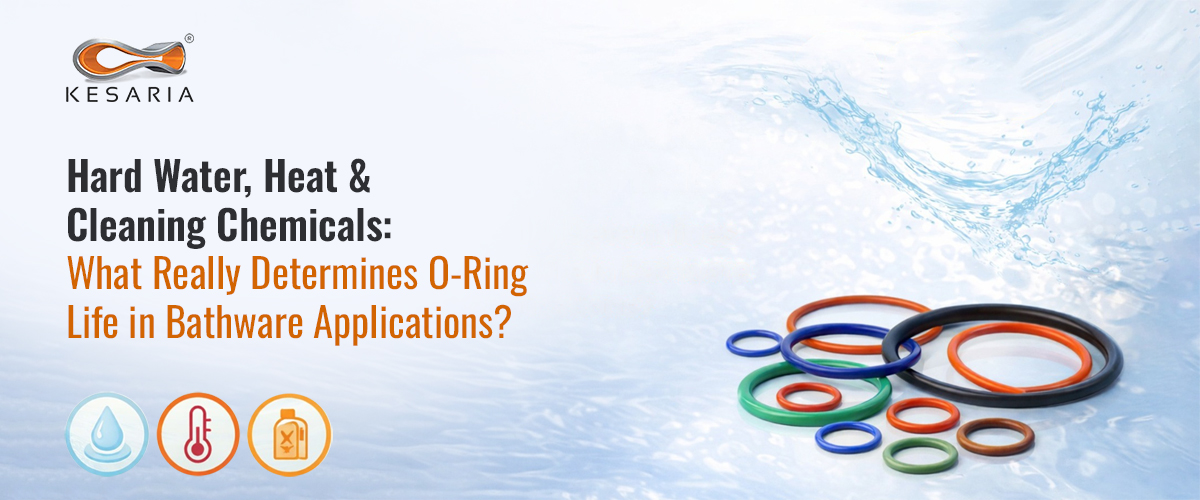
In bathware products, O-rings are rarely visible but they are critical. Inside faucets, diverters, mixers, and concealed water channels, these small elastomeric components work continuously under pressure to prevent leakage.
When they fail, the consequences are far from small: internal leakage, reduced flow performance, premature product failure, warranty claims, and damaged brand credibility.
While size and fit are important, the real determinants of O-ring life in bathware applications are environmental. In most real-world installations, three factors dominate: hard water, temperature variation, and exposure to cleaning chemicals. Understanding how these interact is essential for manufacturers aiming for long-term product reliability.
1. Hard Water: The Silent Accelerator of Seal Degradation
In many regions, especially across India, the Middle East, and parts of Africa, water contains high levels of calcium and magnesium salts. Over time, hard water deposits accumulate inside internal channels and around sealing interfaces.
For O-rings, this creates two major problems:
-
- Surface abrasion and micro-damage as mineral deposits form and break away during flow.
- Loss of elasticity when deposits interfere with proper compression and recovery
Even a well sized O ring can begin to leak when scale buildup prevents uniform sealing. Materials with poor resistance to mineral interaction or low compression-set resistance tend to harden faster in these conditions, shortening service life significantly.
2. Heat & Temperature Cycling: More Than Just a Rating Issue
Most bathware systems operate under repeated hot-cold cycles rather than constant temperatures. A faucet may experience near-ambient temperatures for hours, followed by sudden exposure to hot water, several times a day.
This thermal cycling causes elastomers to expand and contract repeatedly.
Over time, this leads to:
-
- Compression set increase
- Loss of sealing force
- Micro-cracks that initiate internal leakage
A common mistake is selecting O-ring materials based only on maximum temperature rating. In reality, chemical exposure at elevated temperatures accelerates degradation far faster than heat alone. A material rated for 150–160°C may still fail prematurely when exposed to hot water combined with cleaning residues or dissolved minerals.
3. Cleaning Chemicals: The Overlooked Enemy
Modern bathrooms are cleaned aggressively. Detergents, disinfectants, descalers, and acidic or alkaline solutions often enter internal water passages especially in faucets and mixers.
Many commonly used elastomers:
-
- Swell when exposed to oxidisers or solvents
- Soften or lose tensile strength in alkaline environments
- Crack or harden under repeated chemical exposure
For example, NBR performs well with oils and water, but can degrade when exposed to certain cleaning chemicals over time. Without proper material compatibility checks, O-rings may fail even when mechanical design is sound.
4. Why Material Selection Alone Isn’t Enough
While choosing the right elastomer is critical, application-specific engineering plays an equally important role:
-
- Groove design and surface finish affect seal stability
- Compression levels influence long-term recovery
- Tolerance control impacts micro movement and wear
In bathware applications, where aesthetics, durability, and low maintenance are non-negotiable, sealing performance must be engineered, not assumed.
Designing for Real-World Conditions
O-ring failures in bathware products are rarely caused by a single factor. They result from the combined effect of hard water, heat, and chemical exposure over time. Manufacturers that design seals for ideal lab conditions often face surprises in the field.
Long-lasting sealing performance comes from:
-
- Understanding actual usage environments
- Selecting materials based on real chemical and thermal exposure
- Partnering with suppliers who think beyond standard catalog specifications
Because in bathware, what customers never see inside the product often determines how long they trust the brand.
Where the Right Sealing Decisions Begin
At Kesaria Rubber, we understand that bathware sealing challenges don’t come from drawings alone; they come from real water conditions, real temperatures, and real usage patterns.
Our O-rings and sealing components are engineered with application specific material selection, controlled compression behavior, and proven resistance to hard water, heat cycles, and cleaning chemicals.
By working closely with bathware and plumbing manufacturers, we help reduce internal leakage, extend product life, and improve long-term reliability, without overengineering or guesswork.
To explore sealing solutions designed for real-world bathware conditions, visit kesaria.com and connect with our engineering team.