 +91 97181 19993
 info@kesaria.com
 O-Rings
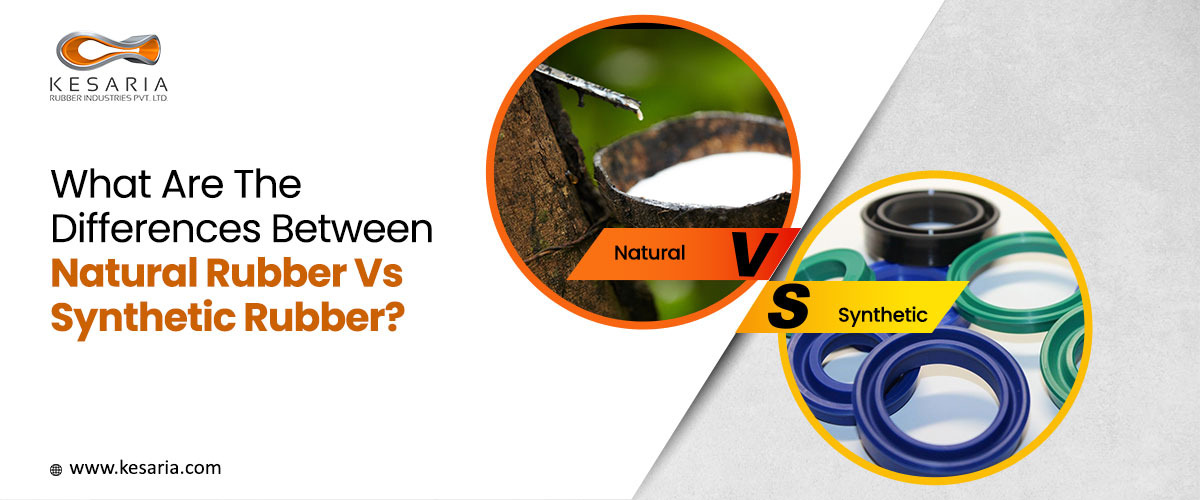
Why some rubber seals last for years while others wear out too soon, the answer often lies in the type of rubber used. Natural or synthetic, both look similar, yet perform very differently.
One gives nature’s gift of flexibility along with strength, whereas the other grants the lab’s creation of durability. Knowing the dissimilarity between the two allows you to select the proper rubber according to your product’s demands in the real world, be it extreme temperature, oil contact, or constant stress.
What Is Natural Rubber?
The latex produced by the rubber tree, Hevea brasiliensis, is the source of natural rubber, which is a polymer. The latex is collected, processed, and formed into sheets or blocks for instant usage in industry. Natural rubber is eco-friendly and compostable, and therefore belongs to the category of resources that, along with being renewable, are still able to meet the sustainability aspirations of most industries.
Key Properties of Natural Rubber
-
- Strong and stretchy
- Flexible and returns to shape even under pressure
- Resists wear, cuts, and tears
- Eco-friendly, biodegradable, and renewable
- Can handle moderate heat, sunlight, and ozone exposure
Common Applications
Natural rubber is widely used for:
-
- Medical and food-grade products
- Automotive tires
- Gaskets and seals
- Shock mounts and bushings
- Hoses and tubings
What Is Synthetic Rubber?
On the other hand, the process of the factory production of synthetic rubber involves the chemical combination of monomers such as butadiene, styrene, or isoprene.
To a significant degree, the use of synthetic rubbers at present has surpassed that of natural ones when comparing the two, as the properties of synthetic rubbers are precisely controlled through the polymerization process, thus the exact properties needed for the application are produced. The commonest types of synthetic rubbers are SBR (Styrene Butadiene Rubber), NBR (Nitrile Rubber), and EPDM (Ethylene Propylene Diene Monomer Rubber).
Key Properties of Synthetic Rubber
-
- Customizable to meet specific application requirements
- Higher durability and abrasion resistance
- Resistance to oils, chemicals, ozone, and extreme temperatures
- Consistent quality and large scale production
- Non-biodegradable (depending on type)
Common Applications
Synthetic rubber is preferred for:
Natural vs Synthetic Rubber: Detailed Comparison
Choosing between natural and synthetic rubber often comes down to the operational environment, expected stresses, and regulatory requirements. Here’s a practical comparison chart:
| Property | Natural Rubber | Synthetic Rubber |
| Source | Plant-based (latex) | Petrochemical synthesis |
| Tensile Strength | High | Moderate to high |
| Elasticity | Excellent | Varies; can be engineered |
| Abrasion Resistance | Good | Moderate to excellent |
| Oil/Chemical Resistance | Poor to moderate | Good to excellent |
| Temperature Resistance | Up to 80–100°C | Up to 180°C or higher |
| Weather/Ozone Resistance | Moderate | Good to excellent |
| Sustainability | Renewable/biodegradable | Usually non-biodegradable |
| Cost | Higher (market dependent) | Usually lower |
| Environmental Impact | Low | Varies (greater if non-recyclable) |
Advantages and Limitations
Natural Rubber
Advantages:
-
- Outstanding mechanical strength and flexibility.
- Excellent for dynamic and vibration applications
- Eco-friendly for food, medical, and eco-conscious uses
Limitations:
-
- Limited resistance to oils, solvents, and harsh chemicals
- Degrades with long exposure to UV, ozone, and high temperatures
Synthetic Rubber
Advantages:
-
- Tunable properties to suit specialized needs
- Superior heat, ozone, and chemical resistance
- Cost-effective
Limitations:
-
- It can have lower mechanical strength compared to natural rubber
- It can be less sustainable if not recycled
Conclusion
The choice between natural and synthetic rubber isn’t about which is better it’s about which is better for your specific application.
If you’re not sure which rubber type fits your requirements best, Kesaria Rubber’s technical experts can guide you toward the most efficient, durable, and eco-friendly solution for your project.