 +91 97181 19993
 info@kesaria.com
 O-Rings
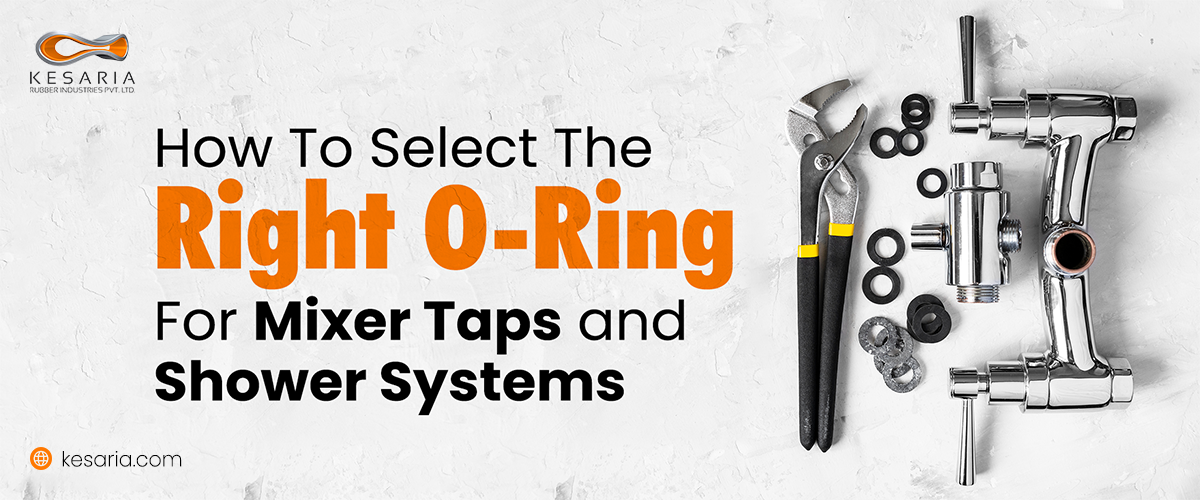
A leaking mixer tap rarely fails because of design. In most cases, the issue starts with the wrong O ring.
In plumbing systems, O-rings work silently inside cartridges, diverters and shower assemblies. They handle pressure changes, temperature shifts, water impurities and daily movement. When the wrong material or size is selected, failure may not happen immediately, but it will happen over time.
At Kesaria, we often see that O-ring selection is treated as a standard procurement decision. In reality, it is an engineering decision.
Understand the environment
The first step is understanding the environment. Mixer taps and shower systems operate under both hot and cold water cycles. In many households, water temperature can range from room temperature to 70–80°C within minutes. The O-ring must remain flexible across this entire range. If the material hardens under heat, sealing force drops. If it softens too much, it may deform permanently. Material choice is therefore critical.
For most plumbing applications, EPDM is widely preferred because it offers strong resistance to water, steam and mild chemicals. It performs well in hot water and does not degrade quickly in humid environments. NBR may work in some cases, but it is more suited to oil-based systems rather than continuous hot water exposure. Silicone provides flexibility at extreme temperatures but may not always offer the same mechanical strength needed in dynamic sealing points.
Being an O-ing manufacturer, we recommend choosing the right component because the wrong compound may not cause immediate leakage, but it can reduce the product’s life cycle significantly.
EPDM, NBR & Silicone O-Rings →
Compression set
Another major factor is the compression set. In simple terms, an O-ring should return to its original shape after being compressed. In mixer taps, O-rings remain compressed for long periods. If the rubber loses elasticity, it cannot maintain sealing pressure. This is one of the most common reasons for slow leaks in bathroom fittings.
Dimensional accuracy
This is equally important. An O-ring that is slightly oversized may twist during installation. One that is undersized may not seal properly. Groove design and cross-section thickness must match precisely. In modern bathware systems where smooth handle movement is expected, excessive friction caused by incorrect sizing can also affect user experience.
Water quality
Water quality in some regions is hard mineral deposits and chlorine exposure can gradually affect rubber surfaces. Swelling, cracking or surface wear reduces performance over time. Selecting a compound tested for such exposure conditions helps extend product life and reduce service complaints.
Pressure variations
Another overlooked factor is variations in pressure. Shower systems and mixer taps may face sudden pressure spikes. The O-ring must maintain sealing integrity even during these fluctuations. A weak or poorly selected seal can fail under repeated stress cycles.
From a brand perspective, the O-ring directly impacts reputation. A premium faucet that leaks after one year damages customer trust. Since O-rings are low-cost components compared to the overall assembly, compromising on quality can lead to high warranty and service costs.
The right selection approach combines:
-
- Suitable material for water and temperature conditions
- Low compression set properties
- Accurate dimensions and tolerance control
- Chemical and hard water resistance
- Stable performance under pressure cycles
Though small in size, an O-ring defines whether a mixer tap performs reliably for years or develops early leakage. In plumbing systems, sealing performance is not visible until it fails. Careful O-ring selection ensures that it never does.