 +91 97181 19993
 info@kesaria.com
 O-Rings
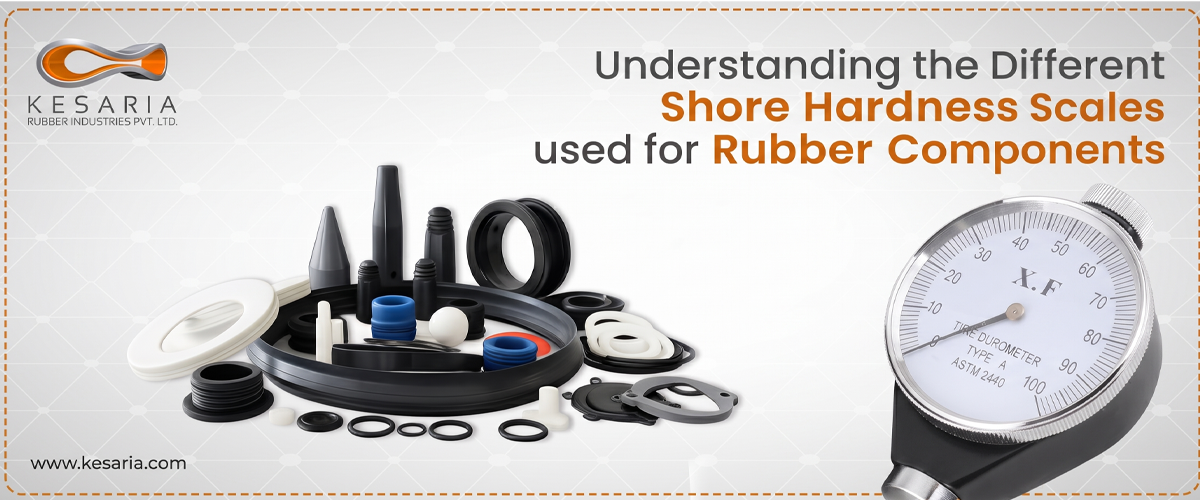
When specifying a rubber component, factors such as material type, chemical resistance and temperature performance often receive significant attention. However one property that plays an equally important role in determining performance is hardness.
Hardness influences how a rubber component responds to pressure, deformation, wear and sealing forces. To measure this property, manufacturers and engineers use Shore hardness scales. Understanding these scales is essential for selecting the right rubber component for a given application.
What Is Shore Hardness?
Shore hardness is a measure of a material’s resistance to indentation. It is determined using a device called a durometer, which applies a standardized force to the surface of the material and measures the depth of indentation.
The higher the Shore hardness value, the harder the material. Conversely, lower values indicate a softer and more flexible material. For rubber components, hardness directly impacts characteristics such as sealing performance, compression resistance, flexibility and durability.
Why Different Shore Hardness Scales Exist
Rubber and elastomeric materials vary widely in their softness and rigidity. A single measurement scale cannot accurately assess all material types. As a result, different Shore hardness scales have been developed to accommodate various material ranges. The most commonly used scales for rubber components are Shore A and Shore D.
Shore A: The Standard Scale for Rubber Components
Shore A is the most widely used hardness scale for elastomers and flexible rubber materials.
Typical applications include:
Most industrial rubber components fall within a Shore A hardness range of 40 to 90.
For example:
- 40 Shore A: Soft and highly flexible
- 70 Shore A: Common for general-purpose sealing applications
- 90 Shore A: Firm with higher resistance to deformation
- Shore A measurements help engineers balance flexibility and sealing effectiveness based on operating conditions.
Shore D: For Harder Rubber and Plastic Materials
When materials become too hard for accurate Shore A measurement, Shore D is used.
This scale is typically applied to:
-
- Hard rubber compounds
- Polyurethane components
- Engineering plastics
- Structural elastomer parts
Materials measured on the Shore D scale offer greater rigidity, wear resistance and load-bearing capability compared to softer elastomers.
Hardness Selection Is Never a One-Number Decision
At Kesaria, hardness is never selected in isolation.
While Shore values provide an important starting point, they are only one part of the engineering decision. Two rubber compounds with the same Shore hardness can perform very differently depending on their polymer type, formulation, operating temperature, chemical exposure and compression characteristics.
That is why our engineering team evaluates the complete application before recommending a compound. Instead of asking,
“What hardness do you need?“ we first ask, “What does the component need to do?“
By understanding the actual operating conditions, we can recommend a compound that balances sealing performance, durability, flexibility and service life rather than simply matching a specification on a drawing.
How Hardness Impacts Performance
Selecting the appropriate hardness is critical because it directly affects component functionality.
A softer rubber compound may provide better conformity to mating surfaces and improved sealing at lower pressures. However, it may wear faster or deform under heavy loads.
A harder compound generally offers better abrasion resistance and dimensional stability but may require greater sealing force and may not adapt as easily to surface irregularities.
The ideal hardness depends on the application’s pressure, temperature, fluid compatibility, movement and service life requirements.
Conclusion
Shore hardness is much more than a specification on a technical datasheet. It is one of the key factors that determines how a rubber component seals, resists wear and performs throughout its service life.
Kesaria believes hardness should never be selected based on a standard value alone. Every sealing application has unique operating conditions and the right solution comes from evaluating the complete picture, including material selection, hardness, geometry and service environment.
By combining over 34 years of material expertise with application specific engineering, we help customers select rubber compounds that deliver consistent sealing performance, longer product life and greater reliability in demanding environments.
Because in sealing applications, the right hardness is not simply a number. It is an engineering decision that directly impacts product performance.