 +91 97181 19993
 info@kesaria.com
 O-Rings
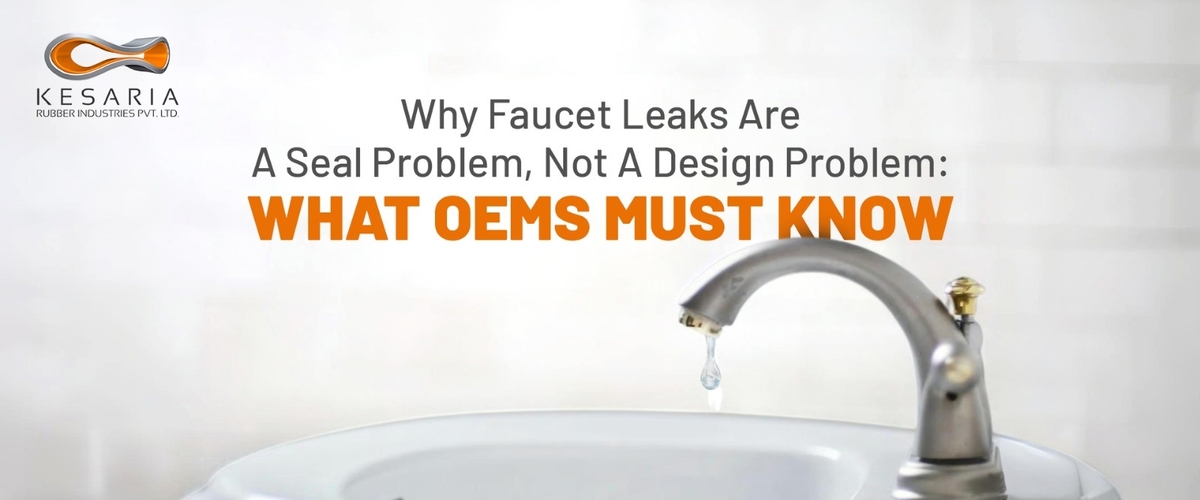
When a faucet starts leaking, the first instinct for customers and sometimes even OEM teams is to blame the design. Maybe the valve geometry is flawed. Maybe the cartridge is built incorrectly. Maybe the mixing mechanism isn’t aligned.
But in more cases than most OEMs realize, the real culprit isn’t the faucet design at all. It’s the O-ring. A tiny component, often overlooked, ends up determining whether a faucet offers years of flawless performance or becomes a recurring service complaint.
In an industry where reliability is reputation, understanding the real engineering behind leaks is essential.
The Hidden Truth: 80% of Faucet Leaks Originate from O-ring Failures
Modern faucet designs have evolved dramatically; precision machining, ceramic cartridges, high-tolerance metal bodies and advanced aerators are now industry standard. Yet leaks remain one of the most common customer complaints.Why?
Because even with perfect design, a poor-quality seal disrupts performance in three critical ways:
1. Micro-Gaps from Improper Compression
Seals must maintain a precise compression range. If the hardness, thickness, or tolerance deviates even slightly, microscopic gaps appear. These gaps allow:
- Drips from the spout
- Leakage around the cartridge
- Backflow issues
This isn’t a design flaw, it’s a seal consistency flaw.
2. Material Incompatibility with Water Chemistry
Different regions have drastically different water properties: chlorine levels, hardness, pH, temperature variation. A seal that isn’t engineered for specific water conditions becomes brittle, swells, cracks, or loses elasticity.
The result: Internal leaks, inconsistent flow, and premature seal failure.
3. Wear and Friction from Cartridge Dynamics
Whether single-lever or dual-control, cartridges create constant friction against the seal. If the seal material lacks:
- Low compression set
- Thermal stability
- Wear resistance
- Smooth surface finish
…it will deteriorate quickly, causing leaks despite a perfectly engineered cartridge. This is why OEMs often see the same model performing well in some markets but failing in others. The design is consistent; the seals are not.
Why Design Isn’t the Root Cause
Let’s break down the misconception.
Even the most precisely engineered faucet depends on a “soft component”, the seal to create a watertight interface. A faucet design can be flawless on CAD, tested under load conditions, and validated for flow mechanics… but the moment seal quality drops, all reliability assumptions collapse. A faucet is only as good as the seal that protects it.
Good Design + Poor Seal = Failure
Good O-ring+ Good Design = Long-Term Reliability
OEMs who invest heavily in user-centric, ergonomic, and aesthetic faucet designs often unknowingly weaken their product performance by selecting seals based on cost instead of performance.
Understanding What a High-Performance Seal Looks Like
A reliable faucet seal must be engineered with the following characteristics:
1. Precision Tolerances
Minor variations, even 0.1 mm can create leakage pathways. Top-tier manufacturers ensure extremely tight dimensional consistency for every batch.
2. Low Compression Set
The seal must return to its original shape after every compression cycle. A high compression set equals leak potential.
3. Chemical & Water Compatibility
The seal must withstand chlorinated water, hard water ions, temperature fluctuations and clean chemical exposure.
Wrong material = inevitable degradation.
4. Smooth Surface Finish
The smoother the seal, the better it performs. Rough surfaces create pathways for micro-leaks and accelerate wear.
5. Material Engineering for Dynamics
Faucet operations involve rotational, axial, and radial movement.
Seals must endure friction without loss of elasticity.
How Seal Quality Impacts OEM Reputation
Faucet failure isn’t just a technical issue, it’s a brand issue.
A customer doesn’t see the seal. They see:
- Leaking faucets
- Stiff controls
- Dripping spouts
- Inconsistent flow
- Reduced lifespan
Every service call erodes brand trust, increases warranty costs, and impacts repeat purchases.
OEMs who switch to high-quality, engineered seals see:
- Drastic reduction in warranty claims
- Better performance consistency across geographies
- Higher customer satisfaction
- Longer product lifespans
- Improved brand reputation
The ROI is extremely high and immediate.
The Future of Faucet Engineering: Precision Sealing
With thinner profiles, designer faucets, and water-efficient mechanisms becoming mainstream, sealing systems must now meet higher performance standards than ever before. Faucet engineering is evolving. Seals must evolve with it.
The industry is shifting toward:
✔ Multi-material sealing systems
✔ High-precision PTFE & rubber components
✔ Long-life elastomers
✔ Region-specific water-compatible materials
✔ Zero-maintenance sealing technology
OEMs that adopt advanced sealing solutions today will lead the market tomorrow.
Kesaria: Your O-Ring Manufacturer for Reliable Faucets
For decades, Kesaria, a leading O-ring manufacturer, has specialized in precision-engineered O-rings and sealing solutions for the sanitaryware and faucet industry. By focusing on dimensional consistency, advanced material formulations, and application-specific engineering, Kesaria ensures that faucets don’t just look great, they perform flawlessly for years. Because at the end of the day,
A great faucet design starts with a great O-ring.