 +91 97181 19993
 info@kesaria.com
 O-Rings
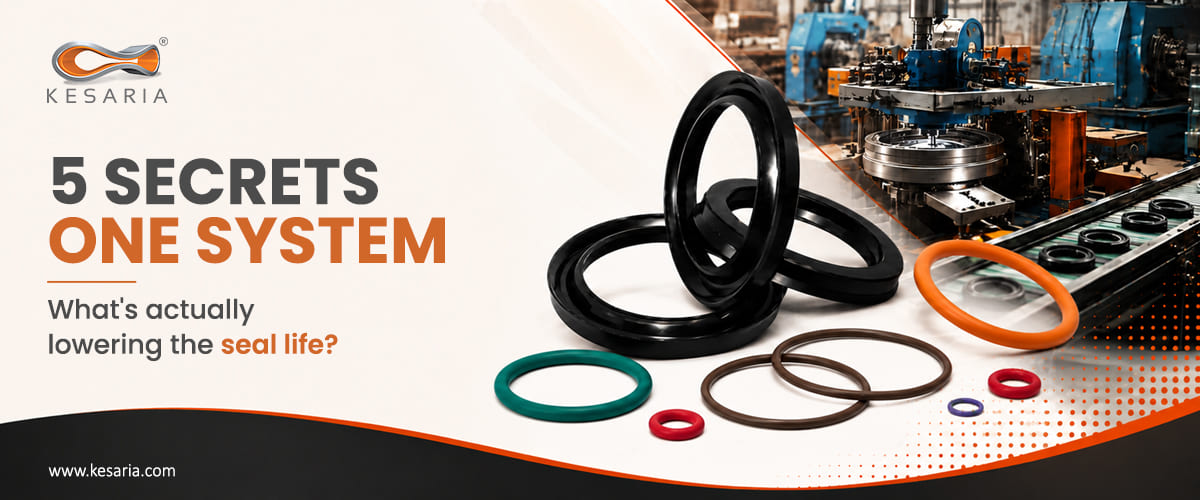
Most O-ring guides talk about shelf life, how long a ring sits in storage before use. That’s not what actually worries you on the shop floor. What matters is service life, how long an O-ring performs once it’s installed and under load.
Increasing O-ring life isn’t about picking a “better” material off a datasheet. It comes down to five factors working together: compound choice, groove design, installation, compression set and testing. Get one wrong and the rest won’t save you. Here’s what actually decides whether your O-ring lasts months or years.
1. Compound Selection Against Real Operating Conditions
Not every rubber behaves the same way in the same conditions.
Nitrile handles hydraulic oils well but weakens with weather exposure. Viton takes on heat and harsh chemicals but costs more. EPDM is built for water and steam, not oil.
Put an EPDM O-ring in an oil line and it won’t just wear out slowly. It swells, turns soft and sticky and can jam the assembly within days. Right material, wrong groove and you’re back to square one.
2. Groove Design And Squeeze Percentage
Even the right O-ring material fails in the wrong groove.
Groove depth decides squeeze, the percentage the O-ring gets compressed once installed. Static seals usually target 15-25% squeeze, dynamic seals 8-20%, though these shift with cross-section size, material hardness, pressure and temperature.
Too shallow and the O-ring over compresses and tears. Too deep and there’s not enough contact force to seal, so it leaks under pressure. Squeeze is what turns a rubber ring into an actual seal. Even a perfect groove can’t save an O-ring that’s damaged before it’s ever put to work.
3. Installation Damage
A lot of “material failures” are actually installation mistakes.
Sharp edges or burrs on the groove can nick the O-ring before it’s even under pressure. Skipping lubrication increases friction and abrasion during fitting.
A 15-20° lead-in chamfer lets the O-ring slide in without catching on edges. Overstretching beyond safe limits during installation weakens the material permanently. None of this shows up on a datasheet, but it’s one of the factors deciding whether the seal holds.
4. Compression Set Over Time
This is why an O-ring that seals perfectly on day one can leak by month six.
Every rubber compound loses some “memory” under continuous compression, it stops springing back to its original shape. That’s compression set.
As it builds up, contact force against the groove drops. Once compression set gets high enough, roughly 80%, the O-ring just sits flat and stops sealing, even with zero visible damage. It’s a slow failure, not a sudden one, which is exactly why it gets missed until the leak shows up. The only way to catch this risk before it happens is testing the batch, not trusting the sheet.
5. Testing And Batch Consistency
A material datasheet tells you what a compound should do. It doesn’t guarantee what a specific batch actually does.
Hardness, tensile strength and compression set can shift slightly between production runs, even when everything looks “in spec” on paper. Manufacturers who batch-test these properties catch the shift before it leaves the plant.
Relying only on a datasheet means trusting an average, not the part in your hand. This gap in O ring lifespan often comes down to whether testing happens in-house or gets skipped entirely.
Conclusion
O-ring lifespan isn’t decided by one factor. It’s compound, groove, installation, compression set and testing working together as one system. Get all five right and your seals outlast the equipment around them.
Kesaria Rubber Industries builds this system into every batch, backed by 35+ years of manufacturing, in-house testing labs and 3 production plants.
If your seals are failing early, it’s worth checking which link in that chain is missing. Connect with our team to see where your current sealing setup stands.