 +91 97181 19993
 info@kesaria.com
 O-Rings
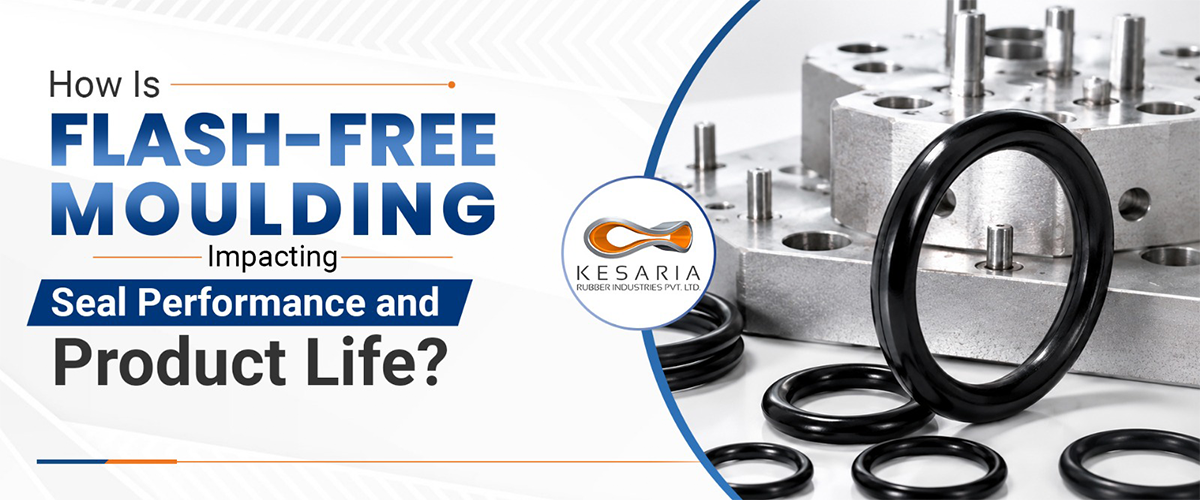
When engineers evaluate rubber seals, the conversation usually revolves around material selection, hardness, compression set, or chemical compatibility. All of these factors are important.
But there is another detail that quietly determines whether a seal performs reliably for years or starts leaking far sooner than expected: flash.
Flash may seem like a minor manufacturing imperfection, but in sealing applications, even the smallest defect can compromise product performance, increase warranty claims and reduce service life.
What Is Flash?
Flash is the thin layer of excess rubber that forms along the parting line of a mould during the moulding process.
During compression, transfer or injection moulding, rubber compound is subjected to high pressure and temperature. A small amount of material naturally escapes into the tiny gap between the mould halves. Once cured, it forms a thin ridge around the component. While some flash is unavoidable during moulding, the real difference lies in how effectively it is removed.
For manufacturers producing precision sealing components, flash removal is not a finishing operation. It is a critical quality process.
Why Flash Matters More Than Most People Think
Many assume flash is simply a cosmetic issue. In reality, it can directly affect sealing performance.
1. Leakage Due to Uneven Sealing
O-rings and gaskets are designed to create uniform contact between two mating surfaces.
Even a small amount of residual flash can interrupt this contact, creating microscopic leakage paths that become more noticeable under pressure or continuous operation.
This is especially critical in plumbing systems, industrial valves, pumps, hydraulic equipment and fluid handling applications.
2. Faster Wear in Dynamic Applications
In applications where seals move continuously against shafts or pistons, raised flash increases friction.
Over time, this accelerates wear on both the sealing component and the mating surface, reducing equipment life and increasing maintenance frequency.
3. Contamination Risks
Improperly removed flash can break away during assembly or operation.
These loose rubber particles can contaminate sensitive systems, particularly in:
- Drinking water applications
- Food processing equipment
- Medical devices
- Precision industrial equipment
In many industries, contamination is not only a performance issue but also a compliance concern.
4. Dimensional Inconsistency
Sealing components rely on precise dimensions. Residual flash changes the cross-section of an O-ring or gasket, making installation inconsistent and affecting sealing performance.
Even slight dimensional variations can result in assembly issues or premature seal failure.
Not Every Deflashing Method Delivers the Same Results
Different manufacturers use different techniques to remove flash. Each method offers varying levels of precision.
Manual trimming
Suitable for simple parts and low production volumes, but consistency depends heavily on operator skill.
Mechanical or tumble deflashing
Uses abrasive media to remove excess material. While effective for certain geometries, it may also affect sharp sealing edges if not carefully controlled.
Cryogenic deflashing
Components are cooled until the flash becomes brittle, allowing it to break away cleanly while leaving the main component unaffected.
For precision sealing products, cryogenic deflashing offers one of the highest levels of consistency and repeatability.
The ideal process depends on the application, part geometry, dimensional tolerances and performance requirements.
Why Flash-Free Components Matter to OEMs
Choosing properly deflashed sealing components delivers benefits that extend well beyond manufacturing.
Reduced Warranty Claims
Cleaner sealing surfaces improve sealing reliability, reducing leak-related failures after installation.
Longer Product Life
Lower friction and improved sealing performance increase component life and reduce maintenance requirements.
Consistent Assembly
Accurate dimensions minimise production issues, improve fitment and reduce assembly line rework.
Lower Total Cost of Ownership
Although precision-manufactured seals may have a slightly higher initial cost, they often reduce service costs, downtime and replacement frequency throughout the product lifecycle.
Questions Worth Asking Your Supplier
Before approving a sealing component supplier, it helps to understand how they control flash removal.
Ask questions such as:
- Which deflashing process do you use?
- Is the process carried out in house?
- How do you inspect components after deflashing?
- Can you demonstrate dimensional consistency between production batches?
- Do you provide approval samples before full scale production?
Reliable suppliers will always have a defined process backed by inspection and quality controls.
Precision Starts Long Before Final Inspection
At Kesaria, flash free moulding is not treated as a finishing step. It begins with mould design, continues through precision manufacturing and is supported by controlled in house deflashing and quality inspection.
Every O-ring, gasket, washer and custom-moulded sealing component is manufactured with one objective: delivering consistent sealing performance throughout its service life.
Because in sealing applications, reliability is rarely determined by the largest component. It is often decided by the smallest detail.
Looking for precision-engineered, flash-free rubber, TPE, or PTFE sealing components?
Connect with Kesaria’s engineering team to discuss your application and identify the right sealing solution for your requirements.