 +91 97181 19993
 info@kesaria.com
 O-Rings
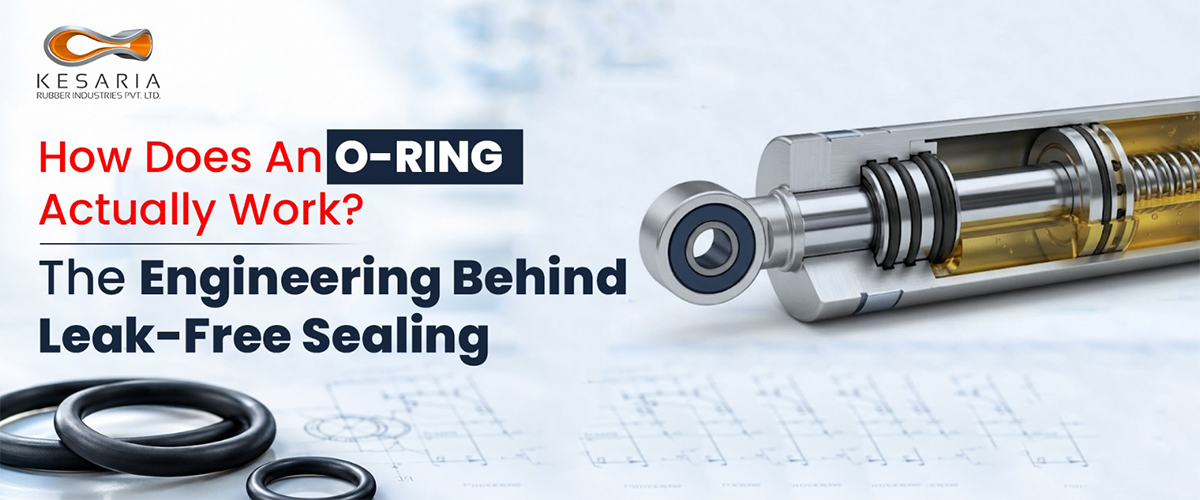
An O-ring does more than simply fill the space between two surfaces. Its sealing action depends on controlled elastic deformation, contact pressure and pressure energisation. So, how does an O-ring work?
In this blog, we’ll explain the O-ring sealing mechanism, how squeeze and gland design create an effective seal and how these factors work together to achieve reliable, leak-free sealing.
The O-Ring Sealing Mechanism: From Squeeze to Seal
Once installed in its gland, the O-ring is compressed between the mating surfaces. This squeeze deforms the elastomer and creates initial contact pressure, closing potential leakage paths. Its elastic recovery helps maintain this contact over time.
When system pressure is applied, the O ring is further pressed against the sealing surfaces, increasing contact pressure and helping maintain the seal.
How System Pressure Energises an O-Ring?
When system pressure is introduced, the fluid pressure acts on the exposed surface of the O-ring. This pushes the elastomer toward the low-pressure side of the gland, increasing its contact with the mating surfaces.
As pressure rises, the O-ring is pressed more firmly against these surfaces, helping maintain sufficient contact pressure to prevent leakage. This is known as pressure energisation and is a key part of O-ring sealing under pressure.
Why O-Ring Squeeze Is Critical to Sealing?
O-ring squeeze must be carefully controlled to create reliable sealing without adding unnecessary resistance. Too little squeeze may result in insufficient contact pressure and leakage, while too much squeeze can increase friction, wear and installation stress. The ideal squeeze also depends on the application.
Static seals generally use different squeeze levels than dynamic seals, where movement makes friction and wear more critical. Gland dimensions, material properties and operating conditions must all be considered when determining the appropriate squeeze.
How Gland Design Controls O-Ring Sealing Performance?
Gland design determines how effectively an O-ring can maintain contact with the sealing surfaces.
– Groove dimensions must provide the right squeeze and sufficient gland space without over-compressing the seal.
– Clearance must also be controlled, as excessive gaps can allow the O-ring to extrude under pressure.
– Surface finish and condition matter too: surfaces that are too rough can damage the O-ring, while unsuitable finishes can affect sealing contact.
Together, these factors directly influence sealing reliability.
What Happens When the Sealing Mechanism Fails?
When an O-ring can no longer maintain enough contact pressure against the sealing surfaces, the sealing interface begins to break down. Even small gaps can provide a path for fluid to pass through, resulting in leakage.
Inadequate squeeze, extrusion, compression set, installation damage or material degradation can all reduce the O-ring’s ability to maintain contact. When contact pressure is no longer sufficient to counter the fluid pressure at the sealing interface, the barrier is compromised and leakage can occur.
Conclusion
An O-ring may be a simple component, but achieving reliable, leak-free sealing depends on getting several factors right. Squeeze, system pressure, gland design and elastomer properties must work together to maintain contact pressure throughout operation.
At Kesaria, we manufacture precision O-rings for OEM and industrial applications, with material and manufacturing considerations aligned to application requirements. Because reliable sealing starts with getting the fundamentals right.