 +91 97181 19993
 info@kesaria.com
 O-Rings
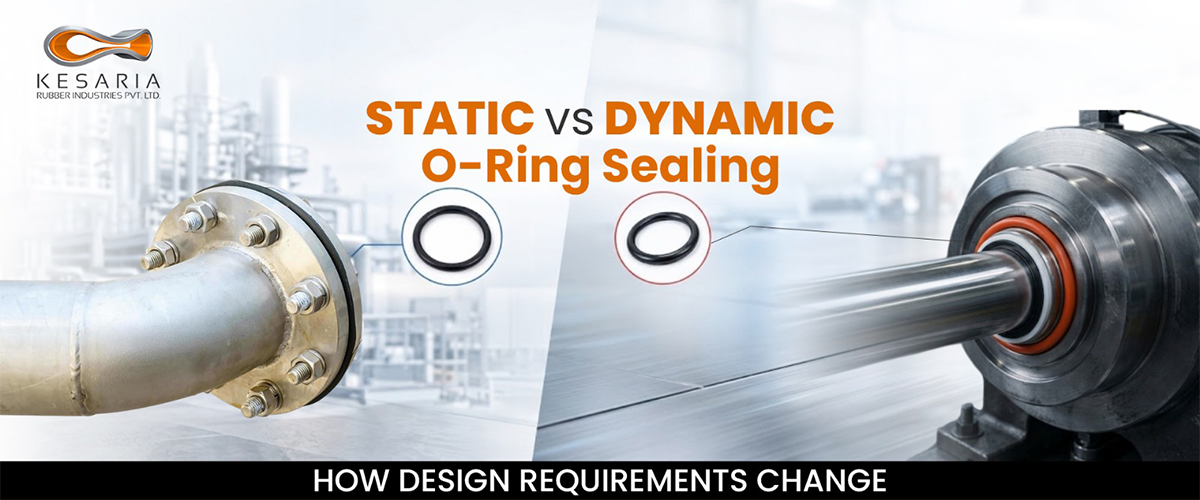
O-rings are widely used to prevent fluid or gas leakage across industrial systems. However, their design requirements change significantly based on how they operate. In a static seal, the mating surfaces remain stationary.
In a dynamic seal, one surface moves against the O-ring, such as a piston, rod or shaft. This movement introduces additional considerations around friction, wear and surface contact.
This blog explains these differences and the key design factors for selecting O-rings for static and dynamic applications.
What Is Static O-Ring Sealing?
Static O-ring sealing is used when the mating components remain stationary relative to each other. The O-ring sits inside a groove and compresses against the sealing surfaces, creating a barrier that prevents fluid or gas leakage.
Common applications include pipe connections, flanges, covers, end caps, hydraulic fittings and pneumatic fittings.
Reliable static sealing depends on the correct O-ring size, groove dimensions, compression, surface finish, pressure and material compatibility.
The right combination ensures consistent contact between the O-ring and sealing surfaces, helping maintain leak-free performance throughout the intended service life.
What Is Dynamic O-Ring Sealing?
Dynamic O-ring sealing is used when the O-ring and its mating surface move relative to each other. It is commonly found in hydraulic pistons, pneumatic cylinders, reciprocating rods, rotary shafts and oscillating components.
The O-ring must maintain sealing contact while handling friction, wear, pressure and movement. Its performance depends on factors such as surface finish, lubrication, operating speed and groove design.
Unlike static sealing, the O-ring experiences continuous movement at the sealing interface. This makes friction and wear control essential for maintaining reliable sealing performance and service life.
Static vs Dynamic O-Ring Design Requirements
The main design difference is movement. Static seals focus on maintaining the right compression, while dynamic seals must maintain sealing contact during movement.
| Design Factor | Static Sealing | Dynamic Sealing |
| Relative movement | None | Present |
| Primary concern | Correct compression | Sealing during movement |
| Friction | Limited concern | Major consideration |
| Wear | Generally lower | Important consideration |
| Surface finish | Important | Critical |
| Groove design | Compression-focused | Movement-focused |
| Lubrication | Application dependent | Often important |
| Operating speed | Not applicable | Must be considered |
A groove designed for a static O-ring should not automatically be used for a dynamic application. Dynamic sealing requires design considerations for movement, friction, wear, speed and lubrication.
What Changes When an O-Ring Has to Move?
When an O-ring operates under movement, several additional factors can affect its sealing performance:
- Friction: Excessive friction can generate heat and accelerate wear.
- Wear:Repeated movement can gradually damage the O-ring and reduce service life.
- Surface finish: Rough mating surfaces can increase friction and wear.
- Extrusion: Pressure can force the O-ring into the clearance gap, especially under higher pressure.
- Speed:Higher movement speeds can increase friction, heat and material wear.
Pressure fluctuations can further increase stress on the seal. Therefore, dynamic O-ring designs must account for movement, pressure, speed, surface finish and clearance to maintain reliable sealing performance.
How to Select the Right O-Ring Design
Before selecting an O-ring, define the application and operating conditions :
- Application: Static or dynamic
- Movement: Reciprocating, rotary or oscillating
- Pressure and temperature
- Fluid or media
- Movement speed
- Surface finish
- Clearance gap
- Required service life
These factors should be evaluated together. Material, O ring dimensions and groove design must be matched to the actual operating conditions to achieve reliable sealing performance.
Conclusion
An O-ring does not seal in isolation. Its performance depends on the complete sealing system and operating conditions. Understanding the difference between static and dynamic applications helps ensure the right design, material and dimensions.
Connect with Kesaria’s technical team for sealing solutions tailored to your application requirements.