 +91 97181 19993
 info@kesaria.com
 O-Rings
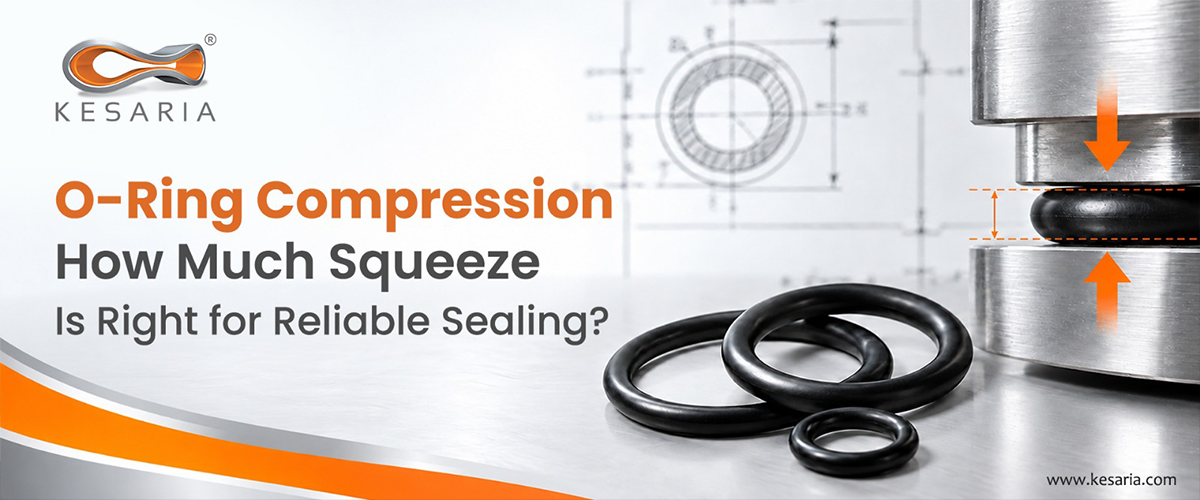
O-ring sealing performance depends on more than material and size. O-ring compression determines how effectively the seal maintains contact with mating surfaces, but both under-compression and over-compression can create problems. How much compression is actually enough for a reliable seal?
In this blog, we’ll look at how squeeze is calculated, how requirements differ between static and dynamic seals, and what factors should guide the final compression level.
What Does O-Ring Compression Actually Mean?
O-ring squeeze refers to the reduction in the O-ring’s cross-section caused by installation in the gland. For a standard gland setup, it is calculated as:
Squeeze % = [(Original cross-section − Gland depth) / Original cross-section] × 100
Squeeze describes a change in shape, while compression force is the load required to create that change. The resulting contact pressure helps the O-ring maintain contact with the sealing surfaces and prevent leakage.
How Much O-Ring Squeeze Is Appropriate?
There is no single squeeze percentage that suits every application.
For static seals, typical guidance is around 18–30%, while reciprocating seals generally use lower squeeze, around 10–20%, to limit friction and heat. Rotary applications may require even lower values.
The right range depends on factors such as seal type, cross-section, pressure, temperature, material, and gland dimensions. These percentages should be treated as design guidelines, not universal specifications.
What Happens When O-Ring Squeeze Is Too Low or Too High?
Too little squeeze means less contact between the O-ring and sealing surfaces. This can make the seal more sensitive to surface imperfections, pressure changes, and dimensional variations, increasing the risk of leakage.
Too much squeeze creates the opposite problem. It increases assembly force and can increase friction and heat in dynamic applications. Over time, this can lead to faster wear and seal damage.
The right amount of squeeze provides enough contact for reliable sealing without putting unnecessary stress on the O-ring.
Squeeze Is Only One Part of O-Ring Design
Squeeze cannot be evaluated on its own.
Reliable O-ring sealing also depends on cross-section, gland depth and width, dimensional tolerances, gland fill, material, hardness, pressure, temperature, media compatibility, surface finish, and whether the seal is static or dynamic.
Gland fill is also important. Keeping it around 60–85% leaves room for dimensional variation, swelling, and thermal expansion.
Conclusion
Reliable O-ring sealing starts with choosing the right squeeze for the complete sealing system.
Cross-section, groove geometry, material, pressure, temperature, and application conditions all influence performance. Increasing compression is not always the answer. The goal is controlled contact without unnecessary stress.
Kesaria manufactures O-rings in multiple materials and sizes, with custom solutions for specific applications. Explore Kesaria’s O ring sealing solutions to find the right fit for your application.