+91 97181 19993
 info@kesaria.com

 O-Rings
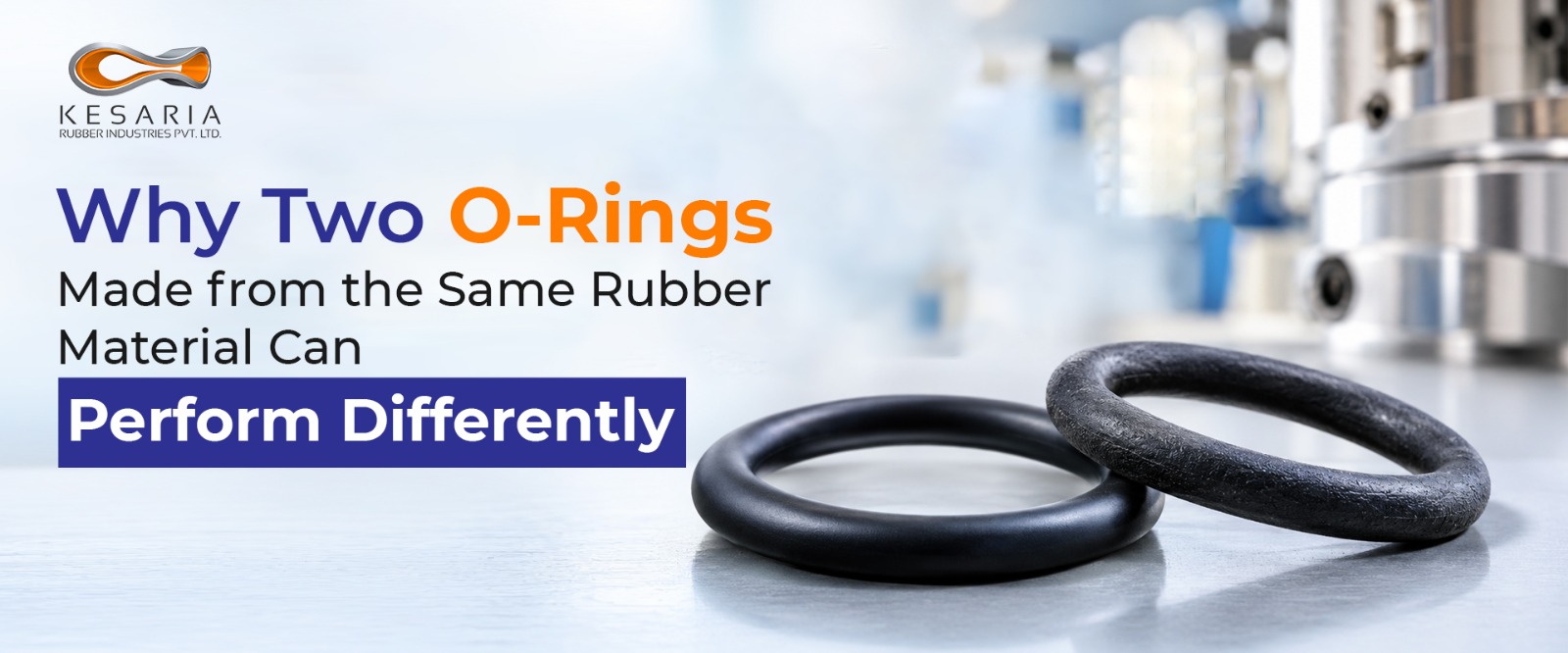
O-rings made from the same rubber type can deliver different sealing performance. Compound formulation, curing processes, dimensional accuracy, and application conditions all influence their behaviour.
This blog explains how these factors affect hardness, elasticity, durability, and overall seal performance.
Same Rubber Type Does Not Mean Same Compound
A base polymer such as NBR, EPDM, or silicone provides the foundation of an O-ring. However, the finished rubber compound contains additional ingredients, including reinforcing fillers, curing agents, plasticizers, and antioxidants. These ingredients influence hardness, elasticity, compression set, and wear resistance.
The curing system also affects the final material properties by controlling how polymer chains form cross-links during manufacturing. As a result, two NBR O-rings can have different mechanical properties and sealing performance, even though they share the same base polymer.
How Manufacturing and Curing Affect Performance
Manufacturing conditions influence the final properties of an O-ring. Curing temperature and duration determine how the rubber compound develops its required properties. Incomplete or inconsistent curing can affect hardness, elasticity, and compression recovery.
Trelleborg identifies incomplete curing as a contributing factor to compression set. Certain compounds may also require post-curing to achieve their specified properties. Controlled curing and consistent production processes help maintain dimensional accuracy and reliable sealing performance across batches.
Why O-Ring Hardness and Dimensions Matter
O-ring hardness affects how the seal deforms under pressure and resists extrusion. Variations in cross-section can change compression and sealing contact. Dimensional accuracy determines how well the O-ring fits inside its groove.
Incorrect sizing, excessive compression, or poor surface finish can cause installation damage, abrasion, or premature failure. Therefore, even identical rubber compounds can deliver different results when their dimensions and physical properties vary.
How Application Conditions Change O-Ring Performance
Even identical O-rings can perform differently under varying operating conditions. Pressure affects seal deformation and extrusion risk, while temperature changes rubber flexibility and compression recovery.
Incompatible fluids can cause swelling, softening, or chemical degradation.
Dynamic applications introduce friction and wear that static seals may not experience. Prolonged exposure to these conditions can accelerate material deterioration, reduce service life, and compromise sealing reliability.
Conclusion
O-ring performance depends on compound formulation, manufacturing quality, dimensions, and operating conditions. Evaluating all these factors helps ensure reliable sealing and longer service life.
Need an O-ring suited to your application? Connect with Kesaria’s technical team for application-specific material and sealing recommendations.